
What happens if you never clean your gutters?
By The Your Gutter Care team Updated 22 October 20265 min read
What happens if you don't clean gutters?
If you're wondering what happens if you don't clean gutters, the answer is: not much at first, and then quite a lot. Gutters fill gradually with leaves, moss and silt. For a while they still cope. Then they start to overflow, and the water that should be heading down the downpipe ends up on your walls, your woodwork and the ground around your house.
None of it happens overnight, and most of it is avoidable. Here's how it usually unfolds when gutters are left alone for a few years, and what each stage looks like from the ground.
Stage 1: overflow and staining
The first thing most people notice is water spilling over the front edge in heavy rain. Debris has built up enough to slow the flow to the outlet, so the gutter fills faster than it can drain.
Every time that happens, water runs down the face of the wall. Over a few months it leaves dark tide marks, green algae and streaks on brickwork, render and uPVC. On white fascias the streaks are usually black, from dirt carried over the edge.
At this stage it's mostly cosmetic. It's also the easiest stage to sort out: clear the gutter and the staining stops getting worse.
Stage 2: damp walls, outside and in
Brick and stone are porous. If they're soaked every time it rains, they never get the chance to dry out, especially through a Greater Manchester winter.
Over time that water can work its way through. You might see damp patches near the top of an upstairs wall, around a window frame, or in the corner of a bedroom ceiling. Paint bubbles, plaster stains, and there's often a musty smell. Outside, render can crack and blow, and mortar joints soften and wash out.
Damp inside has plenty of other causes, of course. But overflowing gutters are one of the most common, and one of the cheapest to rule out.
Stage 3: rotting fascias and timber
The fascia is the board along the edge of the roof that the gutter is fixed to. On older homes it's timber; on newer ones it's usually uPVC.
When a gutter is full of wet debris, the back edge sits constantly wet against the fascia. Water creeps behind it, and timber that stays wet eventually rots. A rotten fascia can't hold the gutter brackets properly, so the gutter starts to sag, which makes the overflow worse. Left long enough, the damp can reach the roof timbers behind it.
Stage 4: plants take root and downpipes block
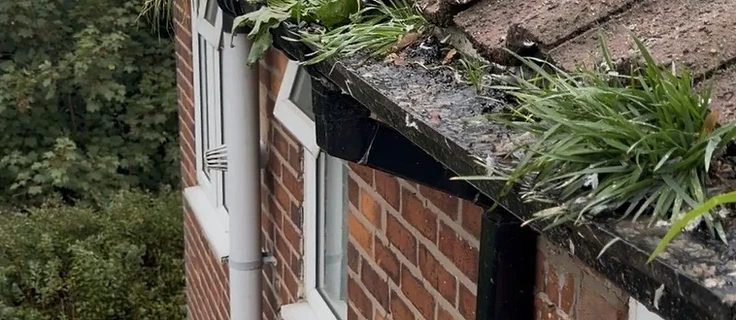
Give a gutter a couple of years and the silt in the bottom becomes something close to soil. Seeds blow in, and grass, weeds and even small tree seedlings start growing in it.
Roots bind the debris into a solid mat and can push gutter joints apart, causing leaks. Bits of root and compacted silt get washed into the outlet and down the downpipe, where they can block the pipe itself. Once a downpipe is blocked, even the clear parts of the gutter can't drain.
Stage 5: water pooling near the foundations
Gutters and downpipes are there to carry roof water to the drain, away from the base of your walls. When they overflow, that water lands right next to the house instead, often in the same spot every time.
You might notice a puddle that never quite dries, a worn or washed-out patch of soil, or splashback staining at the bottom of the wall. Constant soaking at ground level can lead to damp low down on the walls and can wash soil away around paths and footings. It's not usually a disaster on its own, but it's not something to let run for years either.
Stage 6: ice damage in winter
Blocked gutters hold water, and in a cold snap that water freezes. Ice is heavy, and it expands as it forms, which puts strain on brackets, joints and the gutter itself. Joints can split and brackets can pull loose.
When it thaws, the meltwater has nowhere to go but over the edge, sometimes onto paths and steps that then refreeze. Our guide to why gutters overflow covers the other reasons water ends up going over the top.
How to tell how far along yours are
You don't need a ladder to get a rough idea. From the ground, look for:
- Water spilling over the edge when it rains.
- Grass, weeds or moss growing out of the gutter.
- Dark streaks or green staining on the wall below.
- Gutters that sag, or gaps opening at the joints.
- Downpipes that stay dry while it's pouring.
- Damp patches on inside walls near the top of the house.
Our guide to the signs your gutters are blocked explains what each of these means in more detail.
The good news
Most of this is avoidable with a simple routine. For most homes, a clear once a year in late autumn is enough. Homes with trees close by, or on the Pennine side of Greater Manchester, often need it twice.
Our gutter clearing service clears every accessible run from the ground with a high-reach vacuum, up to four storeys, with no ladders or scaffolding. We flow-check the downpipes and send you before and after photos, and if we spot damage like a rotten fascia or a split joint, we'll tell you and show you in the photos. Gutter clearing starts from £74, with a fixed price online and no call-out fee. If yours have been left a while, you can check your price and book online in about a minute.
Common questions
How long can gutters go without being cleaned?
It depends on the house. An open roof with no trees nearby might cope for a year or two before problems show. A mossy roof, or one under trees, can block within a single autumn. As a rule, if your gutters haven't been cleared for more than a year, it's worth watching them from the ground in heavy rain.
Is it too late if my gutters have been left for years?
Usually not. Even gutters full of soil and plants can be cleared, and once water is flowing properly again, the staining and damp stop getting worse. If years of overflow have damaged a fascia, joint or bracket, that may need repairing separately. We'll point out anything we spot and show you in the before and after photos.
Can blocked gutters damage the foundations of a house?
Overflow that keeps landing in the same spot soaks the ground at the base of the wall and can wash soil away around paths. On most homes that won't cause serious structural damage by itself, but constant water at ground level can lead to damp low down on the walls. Keeping gutters and downpipes clear sends that water to the drain instead.
Do plants growing in gutters cause damage?
They can. Roots bind silt into a solid mat that stops water draining, and they can push gutter joints apart, which leads to leaks. Bits of root and debris also wash into the downpipe and can block it. Plants in a gutter are a clear sign it's overdue a clear, rather than something to leave until next year.
Related service
Gutter ClearingWhat's included, and your fixed price online.Areas we cover
We cover Greater Manchester, including all the areas we cover. Not sure about your postcode? Call us on 0161 394 0935.
More guides
Questions about your own gutters? Call 0161 394 0935 or email hello@yourguttercare.co.uk.