
Blocked downpipes and damp walls: what's causing it and how to fix it
By The Your Gutter Care team Updated 22 October 20266 min read
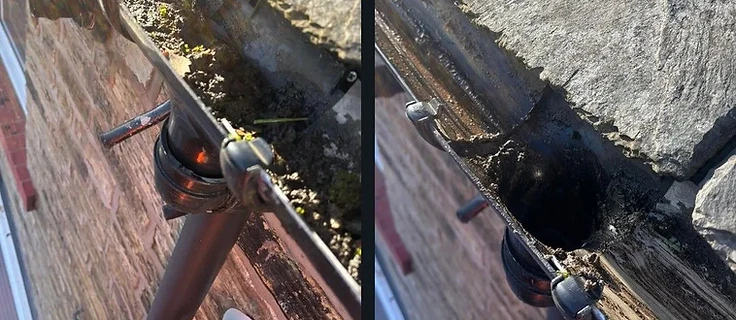
Most damp problems that start at roof level don't begin in the gutter. They begin in the downpipe. A gutter can hold water and still look perfectly clear from the ground, while the pipe that should be carrying that water away is quietly blocked. Once it is, the water has nowhere to go but over the edge, down the wall and into the brickwork. This guide explains how blocked downpipes lead to damp walls, how to tell a pipe blockage from a gutter blockage, and what to do about it.
Blocked downpipes and damp walls: what's actually happening
A downpipe has one job: take water from the gutter outlet down to the drain at ground level. When it blocks, water backs up into the gutter run behind it. The gutter fills, then overflows at the nearest low point — usually a joint, a corner, or the open end of the run.
That overflow is what reaches your wall. It rarely arrives as one dramatic sheet of water. More often it trickles down the brickwork, render or pebbledash over weeks and months. Brick and mortar are porous, so they take that water on and pass it inwards.
Why the gutter can look clear while the downpipe is blocked
This is the part that catches people out. From the ground the gutter looks empty, so it's easy to assume everything is fine. Often it isn't.
The outlet is the first thing to block
The outlet is the hole where the gutter meets the top of the downpipe, and it's the narrowest point in the whole system. Leaves, moss and grit collect there first. A gutter run can be completely clear and still not drain, because the outlet underneath it is capped with debris.
Silt and moss that sets hard
Moss off a tiled or slate roof doesn't stay on the roof. It washes into the gutter, breaks down and settles as a fine silt. Inside a downpipe that silt compacts, and over a season or two it can set hard enough that no amount of rainwater will shift it. It's common on the older stone and slate roofs around Greater Manchester, where moss growth is heavy.
Shared downpipes on terraced streets
On plenty of terraced streets one downpipe serves two or three houses, so everything from several roofs passes through a single pipe. When it blocks, it doesn't only affect the house it's fixed to — water can back up and overflow at a neighbour's end of the run. It's one reason a blockage a few doors away can show up as damp in your house.
If the water is spilling over the gutter itself rather than running down the wall, see our guide to why gutters overflow — the causes there are different.
What the water does once it can't get away
Outside: staining, blown render and green growth
The first visible sign is usually a dark vertical stain on the wall below the overflow point. On rendered or pebbledashed walls, water getting behind the surface can cause it to blow, so the render detaches from the wall in patches. Algae and green growth then follow the damp line, because those surfaces stay wet for longer.
Inside: damp patches, tide marks and a musty smell
Water that soaks into brickwork can eventually reach the inner leaf of the wall. Inside, that often shows up as a damp patch on a wall or ceiling with a tide mark around the edge, and a musty smell in the room. It tends to be worst near the top of the wall and in the corner closest to the downpipe.
How to tell whether it's the downpipe or the drain
Before anyone goes up a ladder, there are two checks you can do from the ground.
The hosepipe test
Run a hosepipe gently into the gutter near the outlet. If water backs up in the gutter and spills over the edge, the blockage is in the outlet or the downpipe. If the gutter drains away freely but water pools at the bottom of the pipe, the problem is below the pipe — in the gully or the underground drain.
The overflow test
Watch the downpipe during heavy rain. A pipe running freely will be wet the whole way down and discharging steadily at the bottom. If the top section is wet and the bottom is dry, water is escaping somewhere it shouldn't be.
Check the gully
At the bottom of most downpipes there's a gully, the small trap that carries the water into the drain. These silt up constantly. If the gully is full of leaves and grit, the pipe above it will back up even when the pipe itself is clear. Our guide to the signs your gutters are blocked covers the other things worth watching for.
Clearing a blocked downpipe
A downpipe is cleared from the top down, not the bottom up. The blockage almost always sits in the upper section near the outlet, and pushing at it from below tends to compact it further.
Our gutter and downpipe clearing is done from the ground with a high-reach vacuum and telescopic poles, so nobody is up a ladder. The vacuum lifts the debris out of the outlet and the top of the pipe, and we flow-test with water afterwards to confirm it's reaching the drain. Where a blockage has set hard, the pipe sometimes needs to come apart at a joint to clear it properly.
If the blockage turns out to be in the underground drain rather than the pipe itself, that's a drainage job rather than a gutter one.
Stopping it happening again
- Clear the gutters and check the downpipes at the same time. A clear gutter feeding a blocked pipe still overflows.
- Book it after the leaves are down. Late autumn is when most of the debris has fallen and the runs are at their fullest.
- Keep the gully clear. Lifting the grit out of the trap at the bottom of the pipe takes minutes and prevents a lot of back-up.
- Note where the stains are. A damp line on a wall tells you which run is struggling, often before it starts overflowing.
Getting a blocked downpipe cleared
Gutter and downpipe clearing across Greater Manchester starts at £74, and the price is fixed before you book — enter your postcode, tell us about your property and you'll see the figure for your address. We're fully insured with £2m public liability cover, and you get before and after photos of every run we clear. You can book a gutter clear online, or call us if you'd rather talk it through first.
Common questions
Why is water running down my wall if the gutter looks clear?
Because the blockage is usually in the outlet or the downpipe, not the gutter run. The outlet is the narrowest point in the system, so it caps over with leaves and moss first — the gutter behind it can be completely empty and still not drain.
Why is the damp worse at one corner of the house?
That's usually where the water is getting out. Gutters overflow at their lowest point, which is normally a corner, a joint or the end of a run, so the wall directly below it takes the most water over the longest period.
Once the downpipe is cleared, will the damp go away?
The source of the water stops, which is the important part, but the wall itself can take a long time to dry out. Brick and mortar hold moisture and release it slowly. Any blown render or damaged plaster will still need repairing.
Can the blockage be underground rather than in the downpipe?
It can. The gully at the bottom of a downpipe silts up constantly, and the drain beyond it can block too. If the gutter drains away freely but water pools at ground level, the problem is below the pipe rather than inside it.
Related service
Gutter ClearingWhat's included, and your fixed price online.Areas we cover
We cover Greater Manchester, including all the areas we cover. Not sure about your postcode? Call us on 0161 394 0935.
More guides
Questions about your own gutters? Call 0161 394 0935 or email hello@yourguttercare.co.uk.